 (My Linkedin page)
Office: School of Integrated Arts and Sciences, C716 (see MAP Link)
E-mail: nagam@hiroshima-u.ac.jp
IEEE CSS Interview (People in Control)
Resume
Curriculum Vitae
List of Publications
ORCID
ResearcherID
Google Scholar Citations
ResearchGate
(My Linkedin page)
My new book Sparsity Methods for Systems and Control has been published!
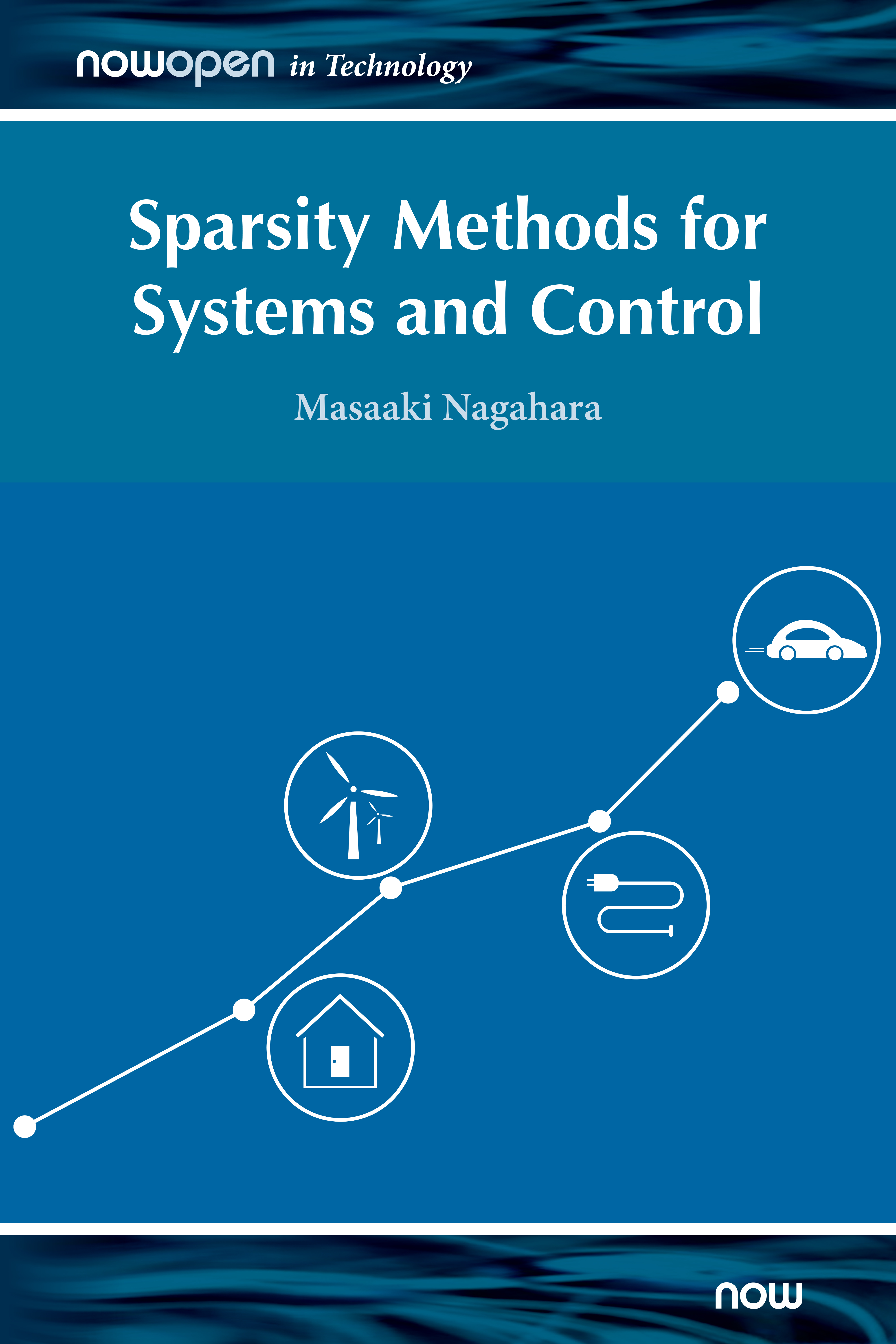
This is an open access book, so you can download pdf from here for free!
Slides and lecture videos are also available at this page.
Book Reviews
Definitely this book will be interesting to broad control, mathematics, and engineering communities. The author should definitely try to expand the book to include sparse control problems in their full generality.
Aleksandar Haber, The City University of New York, USA.The writing style is live and easy to follow. In particular, I like very much the examples, problems, and Matlab simulations with actual code segments that are included in the first chapters. The proposal is timely and the topic of sparsity in control is very broad. In addition, to the systems and control community, I expect it will appeal to the machine learning community.
Ivan Markovsky, Vrije Universiteit Brussels, Belgium.
Masaaki Nagahara received a bachelor's degree in engineering from Kobe University in 1998 and a master's degree and a Doctoral degree in informatics from Kyoto University in 2000 and 2003, respectively.
He is currently a Full Professor at the Graduate School of Advanced Science and Engineering, Hiroshima University. He has been a Visiting Professor at Indian Institute of Technology Bombay since 2017. His research interests include control theory, machine learning, and sparse modeling.
He received remarkable international awards: Transition to Practice Award in 2012 and George S. Axelby Outstanding Paper Award in 2018 from the IEEE Control Systems Society. Also, he received many awards from Japanese research societies, such as SICE Young Authors Award in 1999, SICE Best Paper Award in 2012, SICE Best Book Authors Awards in 2016 and 2021, SICE Control Division Research Award (Kimura Award) in 2020, and the Best Tutorial Paper Award from the IEICE Communications Society in 2014.
He is a senior member of IEEE, and a member of IEICE, SICE, ISCIE, and RSJ.